
CCTV Drain Inspections Explained
What a drain camera actually sees, what the footage tells a plumber, and why we never quote drain repairs without it.
By the Brighton Plumbing Co teamPublished 12 July 2026
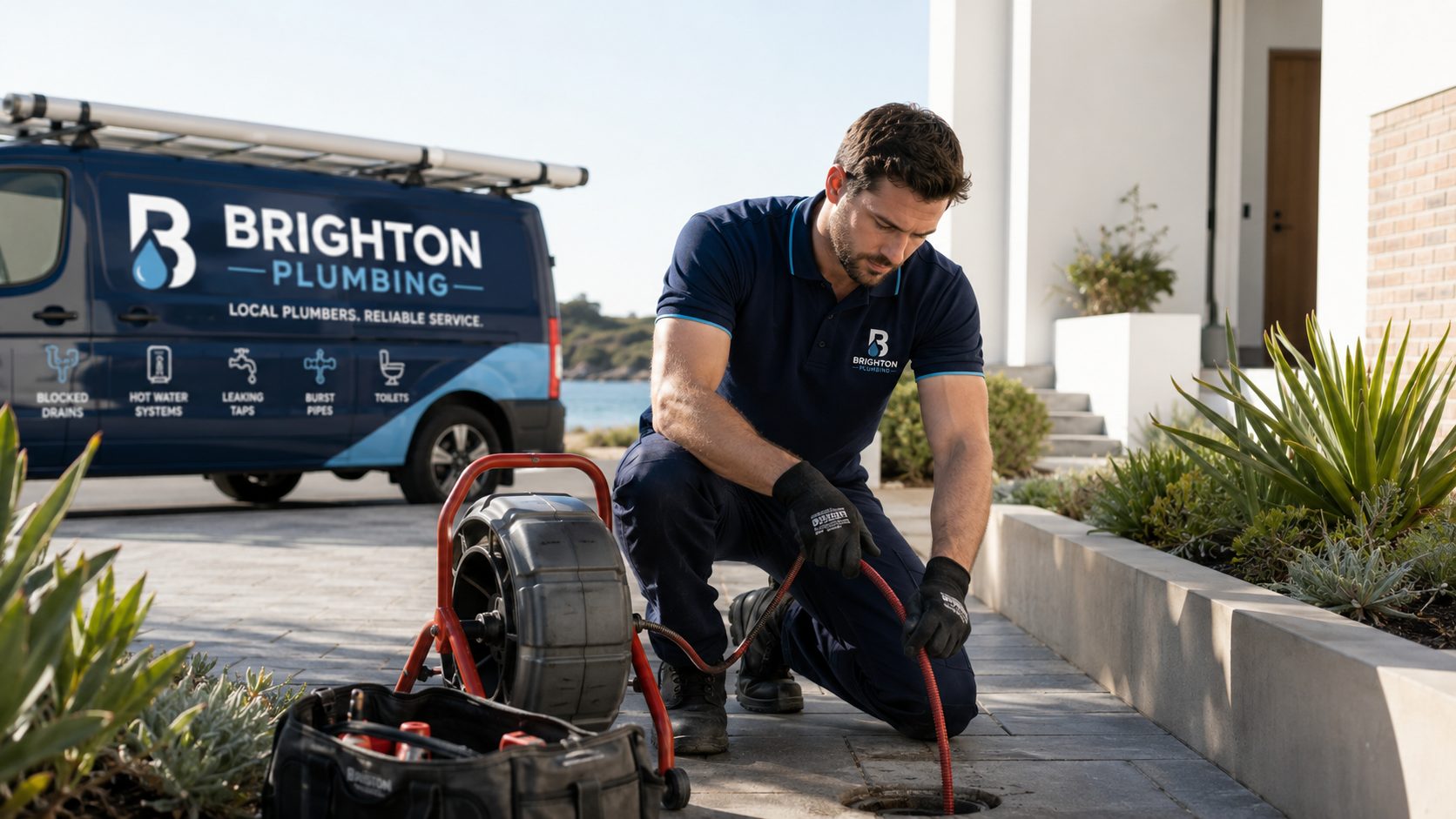
What a drain camera actually is
A CCTV drain camera is a small waterproof camera head on the end of a long flexible push rod, connected to a monitor at the surface. The head carries its own lights, and most units record distance travelled, so a fault can be located not just seen. We feed it into the drain through an inspection opening, the overflow relief gully or an access point we create, and watch the inside of the pipe in real time as the rod goes in.
For deeper diagnostics we pair the camera with a sonde locator. The camera head transmits a signal that a receiver at the surface can pinpoint, so we can stand in your garden and mark the exact spot, and depth, of a broken joint. That single capability is the difference between digging one neat hole and digging up half a garden bed looking for a fault.
What the footage actually finds
Under the older streets of Brighton, Brighton East and Elwood, most drains are earthenware laid in short sections, and the camera tells the story joint by joint. The common findings fall into a few categories.
- Root intrusion: fine root curtains or thick root masses entering at joints, the classic Bayside finding wherever plane trees and figs line the street.
- Displaced or open joints: sections that have moved with the reactive clay soil, leaving a step or gap in the pipe wall.
- Cracks and fractures: from ground movement, vehicle loads over shallow pipes, or simple age.
- Bellies and back-fall: sections that have sunk so water pools instead of draining, which shows up as the camera submerging in standing water.
- Fat and scale build-up: kitchen-line grease or mineral deposits narrowing the bore.
- Foreign objects and bad workmanship: everything from builders rubble to a branch line connected badly decades ago.
- Collapse: the finding that rules out relining and makes excavation unavoidable, and one you want to know about before choosing a repair.
Why footage comes before any quote
A blocked drain has a symptom, not a diagnosis. Slow drainage, gurgling and backups look identical at the surface whether the cause is a wad of wipes, a root mass or a collapsed pipe, and those three problems have completely different fixes. Quoting a repair without footage means quoting a guess, and guesses in drainage tend to be expensive in one of two directions: you pay for more repair than the pipe needed, or you pay for a cheap fix that fails within months.
This is why our sequence for every blocked drain is fixed: clear the blockage so the camera can see, inspect the full line, then quote based on what is actually there. You watch the footage with us, or we send you the recording with the distances of each fault noted. If we recommend a reline, you can see the open joints yourself. If we tell you the pipe is fine and the blockage was one-off misuse, you can see that too, and you keep your money.
The recording is worth keeping regardless. It is a condition report on an asset buried under your home, useful when you sell, when you plan a renovation over the sewer line, or when a future blockage raises the question of whether things have deteriorated.
When an inspection is worth booking on its own
Most inspections happen as part of clearing a blockage, but there are times a standalone camera survey is money well spent.
- Before buying an older home. Building inspections stop at floor level. A drain survey tells you whether a century of earthenware is about to become your problem.
- Before a renovation or extension. If new footings, a slab or landscaping are going over the drainage line, you want to know its condition while it is still easy to fix.
- Recurring blockages. If a drain needs clearing more than about once a year, the footage will show why, and whether continuing to clear it is sensible.
- Persistent smells or damp. A cracked drain can leak into the soil long before it ever blocks, and around Bayside high water tables that shows up as damp subfloors and drain smells.
- After major tree works or ground movement nearby, to check nothing has shifted.
What to expect on the day
A typical residential inspection takes under an hour once there is access to the line. If the drain is blocked, it needs to be cleared first, since a camera cannot see through sewage, and we quote that step before starting. We inspect from the house connection towards the street where possible, note the distance of every defect, and use the locator to mark significant faults on the surface.
You get plain findings in plain language: what we saw, where it is, how serious it is, and what your realistic options are, whether that is doing nothing, scheduled clearing, a patch, a reline or replacement. In Victoria, drainage work itself must be done by a licensed or registered plumber, so whoever inspects your drain should be able to show a licence and stand behind the recommendation. That is how we run every camera inspection across Brighton, Hampton, Gardenvale, Elwood and Sandringham.
Common questions
Can the camera go through a blocked drain?
No. The camera needs a reasonably clear bore and clear water to see anything useful, so a blocked line is cleared first and inspected straight after. That order also means the footage shows the true condition of the pipe rather than the blockage hiding it.
Do I get a copy of the footage?
Yes. We record every inspection and you receive the recording along with our notes on what was found and at what distance. Keep it with your house documents, since it is a dated condition report on your drainage.
Will the inspection damage my old clay pipes?
No. The camera head is pushed gently through the pipe on a flexible rod and touches nothing with any force. It is entirely a look, not an intervention, which is exactly why it is the right first step on fragile old pipework.