Hydro Jetting vs Electric Eel
Two ways to clear a blocked drain, two very different results. An honest comparison of jetting and the eel, and when each one is right.
By the Brighton Plumbing Co teamPublished 12 July 2026
Two machines, two philosophies
Ask three plumbers how they clear drains and you will hear strong opinions about jetters and eels. Both machines have a place on our van, and around the old earthenware drains of Brighton and Bayside we choose between them job by job. Understanding how each one actually works makes the choice obvious rather than mysterious.
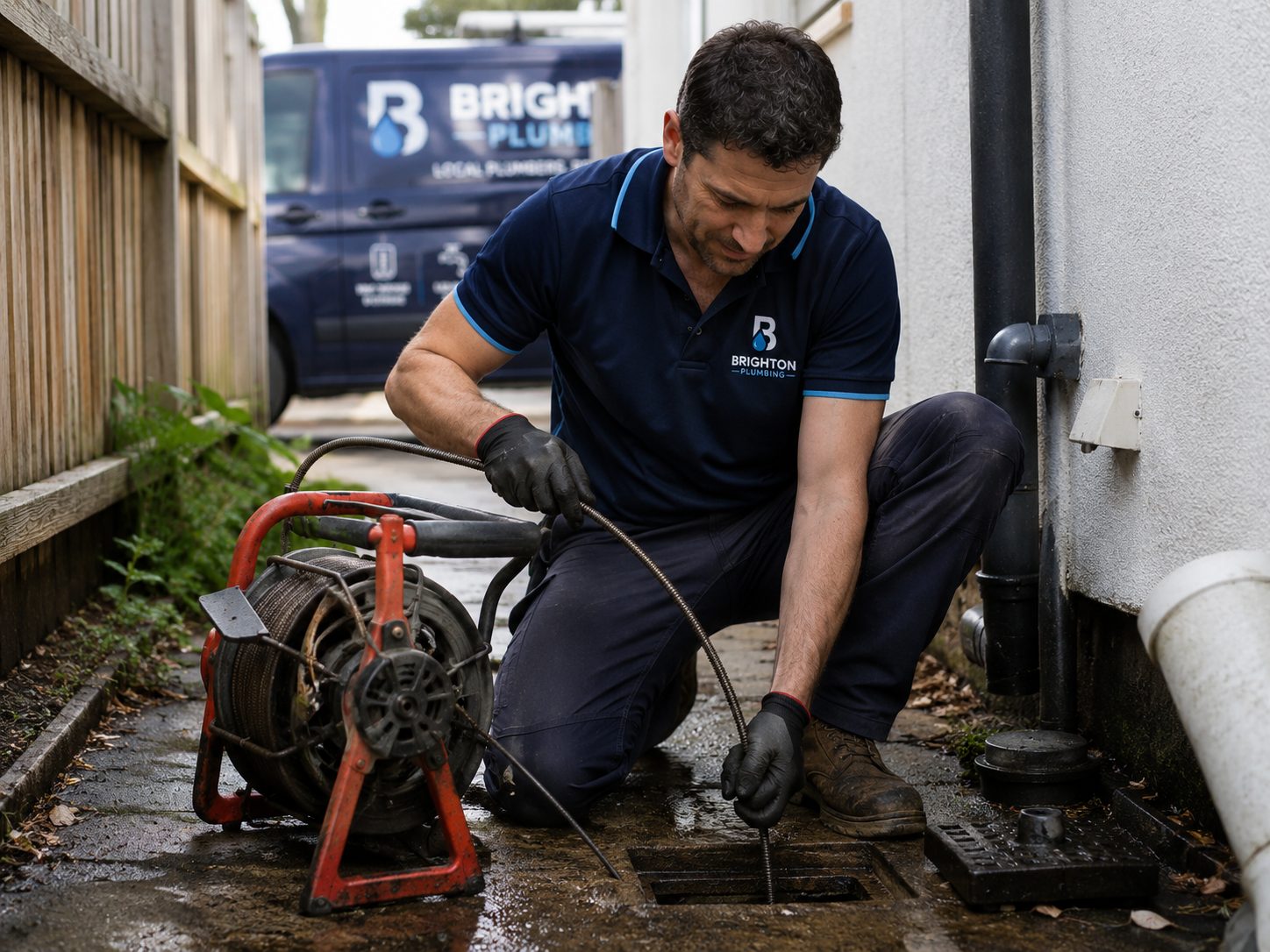
An electric eel, also called a drain machine or plumbers snake, is a motor-driven flexible steel cable with a cutting or retrieving head on the end. It spins as it feeds down the pipe, and the head chews through or hooks whatever is in the way. A hydro jetter is a high-pressure water pump feeding a hose with a specialised nozzle. Rear-facing jets pull the hose down the pipe and scour the walls, while forward jets or a root-cutting head attack the blockage itself.
What the eel does well, and where it falls short
The eel is a boring machine. It drills a hole through the obstruction, which is often exactly what you need: a toilet blocked by an object, a wad of wipes in a short branch line, or a first opening through a hard root mass so water can flow again. Eels are compact, quick to set up, and work in situations where a jetter is impractical, such as clearing through a toilet pan without removing it.
The limitation is in the word hole. An eel cuts a channel through the middle of a blockage and tends to leave material on the pipe walls. Punch through a grease blockage with an eel and you have a drain that flows today and a ring of fat waiting to close up again. On roots, the cable can slap and flail its way past fine curtains without truly cutting them. And on fragile century-old earthenware, an aggressively driven cutting head is one of the few tools that can genuinely damage the pipe, catching on an offset joint or cracking already-weak clay.
What jetting does well, and its honest limits
A jetter cleans the full bore of the pipe. The nozzle scours the walls back to bare pipe as it travels, which is why jetting is the clear winner on grease and scale, and why a jetted drain tends to stay clear longer than an eeled one. With a root-cutting nozzle, high-pressure water slices root intrusions off flush at the pipe wall rather than tearing a passage through the middle. Water is also gentle on old pipes in the way steel is not: it has no rigid head to jam in a displaced joint.
Jetting has real limits too, and it is worth being straight about them. A jetter cannot retrieve an object; flushing a toy or a jar lid further down the line helps nobody, and that is an eel-and-retrieval job or a removal job. Jetting needs a water supply and a larger machine, so access matters. On a badly collapsed pipe, no clearing method fixes anything, and very high pressure in the hands of someone careless can strip an already-failing pipe. Pressure and nozzle choice are judgement calls, which is one reason drain work in Victoria sits with licensed plumbers rather than hired equipment.
How we choose on a real Bayside job
On a typical blocked sewer under a Brighton East clinker brick or a Hampton weatherboard, the decision usually runs like this.
- Roots in old clay pipes: jetter with a root cutter. It cuts roots back to the wall, cleans the joints so the camera can see them, and treats the fragile pipe gently. This is the most common Bayside job and the clearest win for jetting.
- Grease and soap build-up in kitchen lines: jetter. An eel makes a hole through fat; a jetter removes it.
- Blocked toilet or a foreign object: eel or a retrieval head first. Pushing an object deeper with water pressure turns a small job into a big one.
- Tight access or indoor branch lines: often the eel, simply because the machine fits where the jetter does not.
- Unknown cause, drain completely full: sometimes an eel first to get an opening and drop the water level, then the jetter to clean properly, then the camera to diagnose.
The step that matters more than the machine
Whichever machine clears your drain, the job is not finished until a CCTV camera has been down the line. Clearing removes the symptom. The camera shows the cause: which joints let the roots in, whether the pipe is displaced, whether the grease problem is really a back-fall problem. Without that step you are booking the same blockage again on an unknown schedule.
So when you compare quotes for a blocked drain in Brighton, Hampton, Elwood or anywhere in Bayside, the useful questions are not just which machine. Ask whether the price includes clearing and a camera inspection, whether you will see the footage, and what happens if the pipe turns out to be damaged. We carry the jetter, the eel and the camera on the same van precisely so the method matches the drain, and so you leave with an answer rather than just an open pipe.
Common questions
Is hydro jetting safe for old clay pipes?
Yes, when the operator matches pressure and nozzle to the pipe. Water scours without the rigid steel head that can catch on offset joints, which is why we generally prefer jetting on aged earthenware. On a pipe the camera shows to be near collapse, we discuss the risk with you before clearing it by any method.
Which method keeps the drain clear for longer?
For grease and roots, jetting, because it cleans the full bore rather than boring a hole through the blockage. How long any drain stays clear ultimately depends on the condition of the pipe, which is what the camera inspection afterwards is for.
Can I hire a machine and clear the drain myself?
Hire eels exist, but in Victoria work on sanitary drains is legally the domain of licensed or registered plumbers, and an inexperienced operator can wedge a cable in a broken joint or crack old pipework. A jammed hire machine stuck ten metres down a drain is a considerably bigger job than the original blockage.