
Living Near the Beach: What Salt Air Does to Your Plumbing
Salt air quietly shortens the life of hot water units, valves and fittings near the bay. How coastal corrosion works and how to slow it down.
By the Brighton Plumbing Co teamPublished 12 July 2026
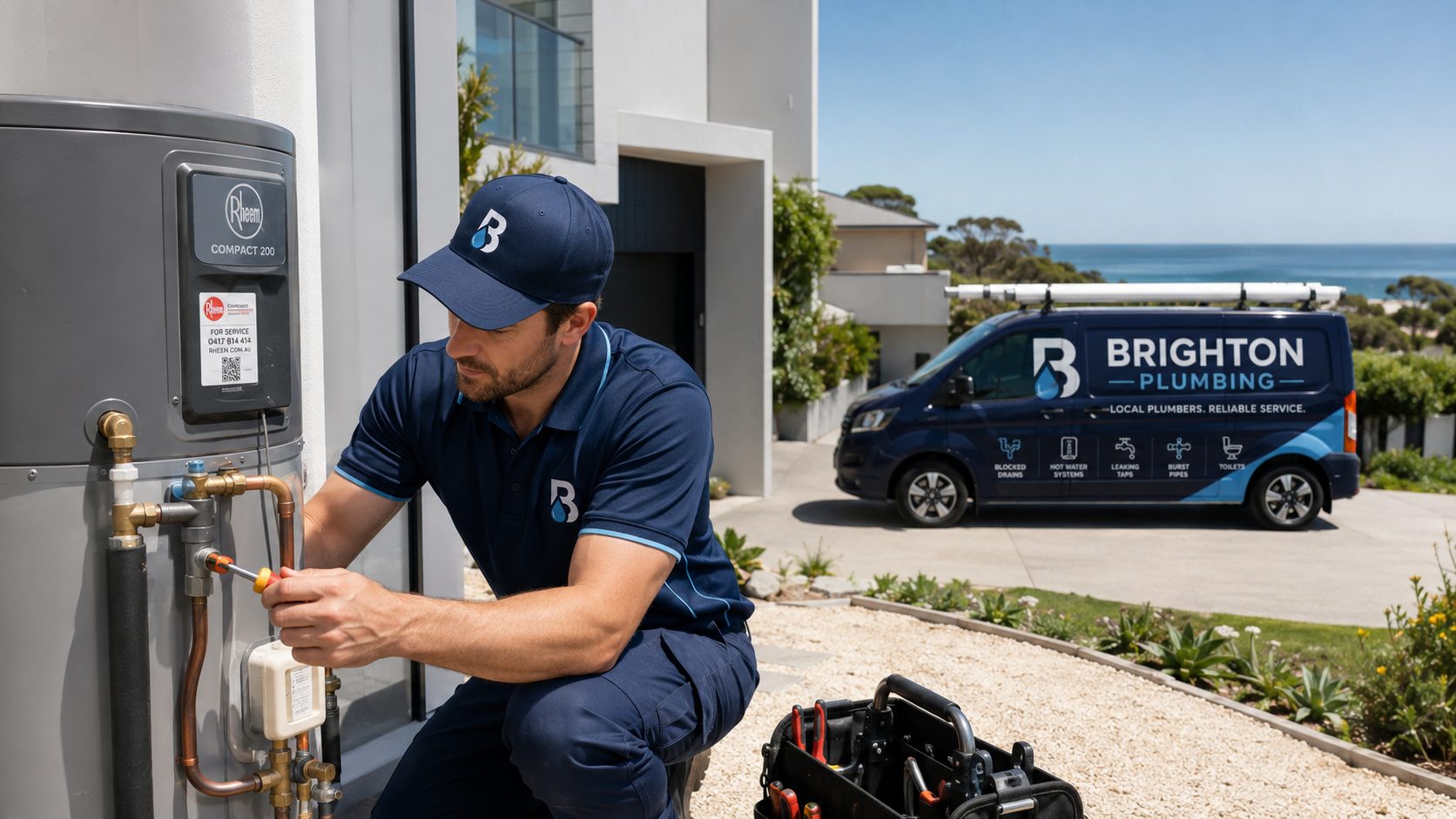
The tax you pay for living near the water
Homes in Brighton, Hampton, Sandringham and Elwood share something beyond the postcode prices: they live in salt air. Onshore winds off Port Phillip carry fine airborne salt spray well inland, and anything metal that lives outdoors is slowly paying for the view. You can see it on garden furniture and car bodywork. You cannot usually see it happening to your plumbing, which is exactly the problem.
As a working rule from the units and fittings we replace, external plumbing hardware within a kilometre or so of the bay ages noticeably faster than the same hardware further inland. An externally mounted hot water unit in Sandringham can look and behave years older than an identical unit of the same age in a suburb away from the water. This article explains where the salt does its damage and what actually slows it down.
How salt air corrodes metal
Corrosion is an electrochemical process: metal gives up electrons to oxygen in the presence of moisture and gradually converts to oxide, which is rust in the case of steel. Salt accelerates this dramatically because dissolved salt makes surface moisture far more electrically conductive, letting the corrosion reaction run faster. Salt crystals are also hygroscopic, meaning they pull moisture from the air, so a salty surface stays damp long after a clean one has dried.
The result near the coast is that every dew-damp morning becomes a small corrosion event. Painted and galvanised surfaces resist until the coating is scratched or worn, then corrode quickly at the breach. Joints between dissimilar metals, brass fittings on steel casings for instance, corrode fastest of all, because the two metals form a small battery with the salty moisture as the electrolyte.
The hot water unit: your most exposed asset
The single most expensive piece of plumbing living outside your house is the hot water unit, and it takes the brunt of coastal exposure. The casing corrodes at seams, screw points and the base, where casing meets drip tray and moisture sits. Gas units add burners and air intakes that draw salty air through the appliance every time they fire. Valves, unions and fittings around the unit weather at their threads and moving parts.
Inside a storage tank, a sacrificial anode protects the steel shell. The anode is a rod of magnesium or aluminium hanging inside the tank that corrodes deliberately so the tank does not: it is more electrochemically active than steel, so the corrosion consumes the rod first. Once the anode is used up, the tank itself starts corroding, and a rusted-through tank is not repairable. Anodes are replaceable, and checking one around the five-year mark, earlier near the bay, is the least expensive way to extend a tank’s life. Most people never do it, which is one reason coastal tanks fail early.
The temperature and pressure relief valve deserves its own mention. It is a safety device that must be able to open, and salt-crusted valves can seize. Easing the test lever gently a couple of times a year keeps it free, and a valve that constantly dribbles or never dribbles at all after easing is telling you it needs replacement.
Valves, taps and fittings: small parts, early failures
Beyond the hot water unit, the salt takes its toll on all the small external hardware: garden taps, isolation valves, backflow devices, water meters and their stop taps, and the exposed unions on rainwater and irrigation systems. The typical failure is not dramatic. Spindles seize, handles snap off corroded stems, and compression joints begin to weep at the threads.
The seized valve is the one that matters most, because valves exist for the day you need to turn something off quickly. A main shut-off that has quietly corroded solid turns a routine burst pipe into a flooded house while you hunt for tools. Our advice for any coastal home is simple: turn every external valve you own through its full travel once or twice a year. A valve that gets exercised stays free. One that sits untouched for a decade in salt air usually does not.
Slowing it down: practical measures that work
You cannot stop coastal corrosion, but you can slow it considerably with placement, materials and small habits:
- Site hot water units out of direct onshore weather where possible: a side of the house sheltered from the bay-facing wind makes a measurable difference
- Rinse external units and fittings with fresh water a few times a year, more often after storms; washing salt off is genuinely effective and costs nothing
- Have the sacrificial anode checked around year five, and earlier for units close to the beach
- Ease the relief valve lever gently a couple of times a year and watch that it reseals
- Exercise every external valve annually so spindles stay free
- Specify marine-grade or dezincification-resistant brass and stainless fixings when fittings are replaced
- Keep coastal exposure in mind when choosing a new system: a well-sheltered heat pump or an internally-mounted unit sidesteps much of the problem
When replacement beats another repair
With coastal units the repair-or-replace question arrives earlier than the brochure suggests. Our rule of thumb: casing corrosion alone is cosmetic and no reason to replace a working unit, but a tank that is weeping from its shell is finished, because the corrosion has won from the inside. A unit past its warranty period with a spent anode, seized valves and heavy external corrosion is usually a better candidate for planned replacement than for a series of distress repairs, each of which arrives as a cold shower at the worst time.
Planned replacement also lets you fix the exposure problem rather than repeating it: better siting, a sheltered position, sacrificial hardware chosen for the marine environment. In Victoria, installing or replacing a hot water system is licensed plumbing work and comes with a compliance certificate for the installation. We do this work across Brighton, Hampton, Sandringham, Elwood and the surrounding suburbs every week, and we will always give you the honest read on whether your unit needs replacing or just needs its anode and valves looked after.
Common questions
How much sooner do hot water units fail near the beach?
There is no fixed number, because exposure varies street by street with distance from the water, shelter and wind direction. What we can say from the units we service is that externally mounted tanks near the bay reliably show corrosion and component wear years ahead of inland units of the same age, and units that get anode checks and an occasional fresh-water rinse last meaningfully longer than those left alone.
Can I check or replace the anode myself?
Checking the outside of the unit, rinsing off salt and easing the relief valve lever are all safe for a householder. The anode itself sits inside the tank under a hex head at the top, and replacing it involves isolating and partly draining the unit, plus working around the tank’s plumbing connections. In Victoria that work should be done by a licensed plumber, and it is quick to do as part of a hot water service.
Is a heat pump hot water system a bad idea in salt air?
No, but siting matters more. A heat pump has a fan and evaporator coil exposed to the air it draws, so a bay-facing position in direct salt spray will age it faster. Sheltered placement, models with coated coils suited to coastal use, and an occasional fresh-water rinse address most of the concern. We factor exposure into the recommendation whenever we quote a coastal replacement.